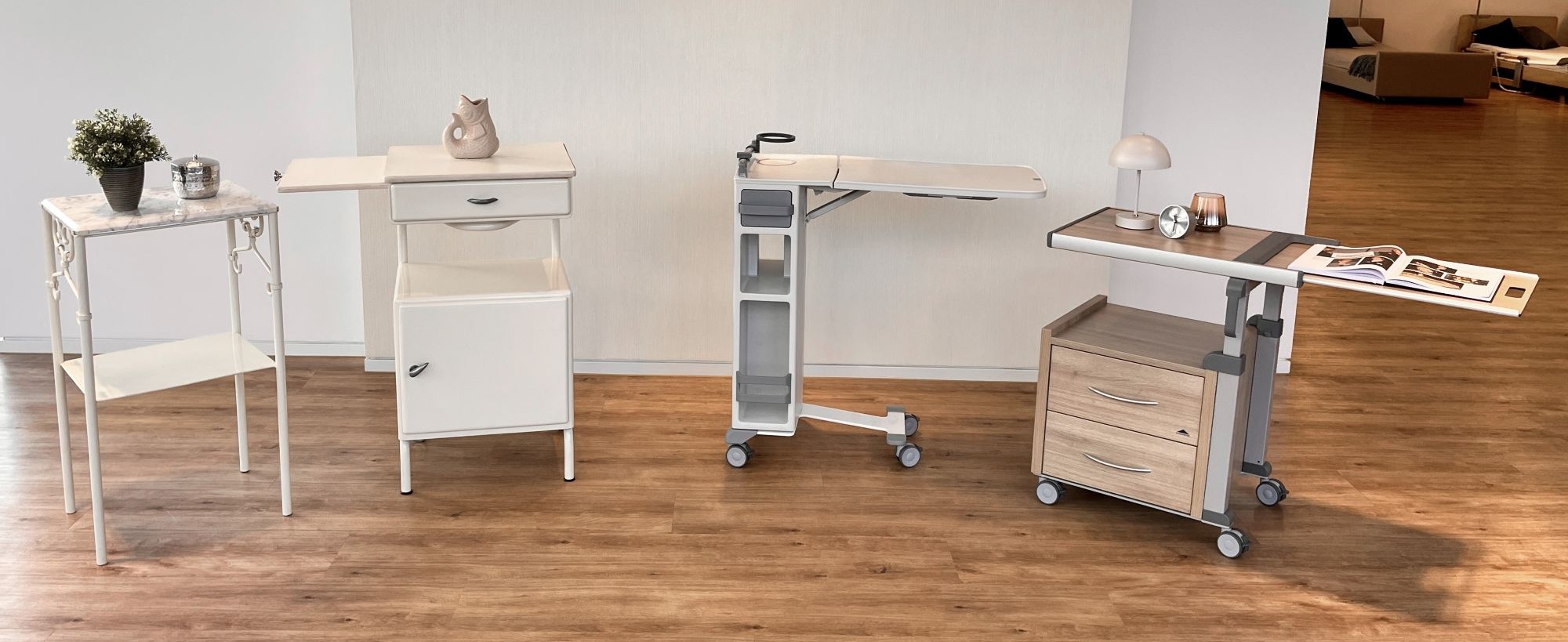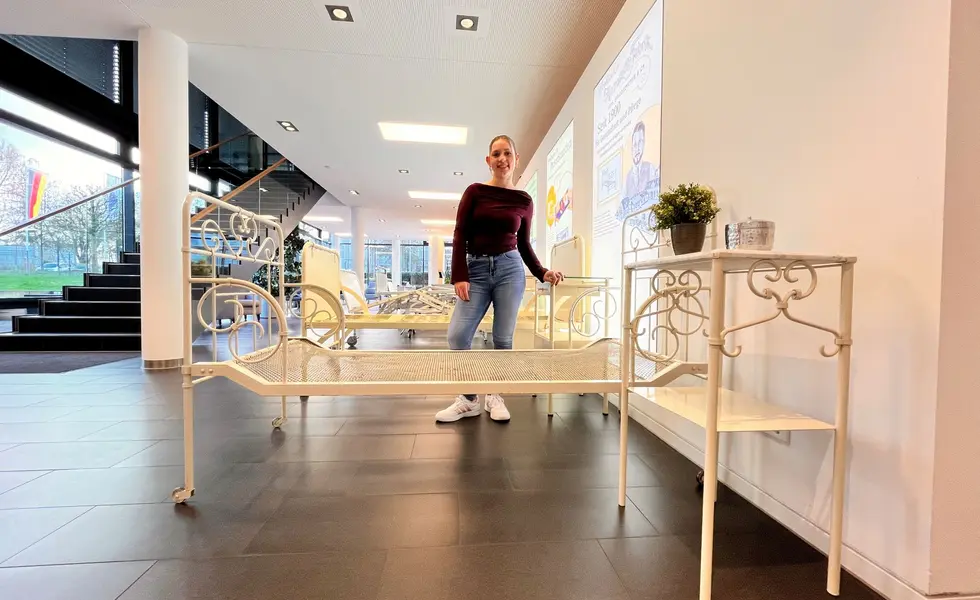
It is already clear at this point that bedside cabinets have played an important role in our 125-year company history from the very beginning. And yet they are always young and new. When our innovative Aparto series of bedside cabinets for nursing homes was launched, the motto was ‘Aparto – bedside cabinets redefined’. An accurate slogan, but one that nevertheless raises the questions: how and when were bedside cabinets previously defined?
The answers to these questions are not easy to find. A simple internet search on the topic of ‘medical bedside cabinets’ doesn't really get you anywhere. Artificial intelligence can dig deeper and find some basic info on how things have changed over time. But the best info comes from our own Stiegelmeyer archives. They show that Stiegelmeyer has always been ahead of the game when it comes to bedside cabinets. When the bedside cabinet was ‘defined’, we were right there.
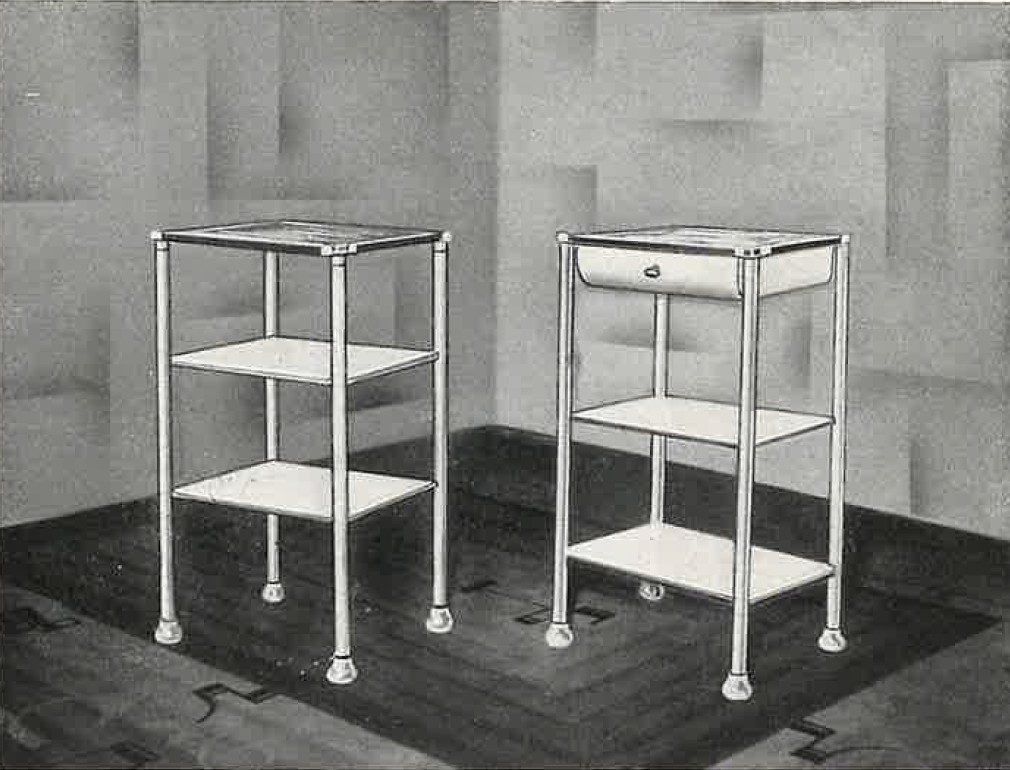
The history of medical bedside cabinets began in hospitals, not in nursing homes, as care furniture only emerged as a separate product category in the late 1960s. However, specially manufactured hospital bedside cabinets have been around since the late 19th century, when there was a growing desire for modern, standardised and hygienic patient care. The Stiegelmeyer bedside cabinets from 1910 represent this first generation. And they already feature a number of characteristics that have remained unchanged to this day: for example, a customisable combination of drawers, open and closed compartments, and smooth, easy-to-clean metal surfaces.
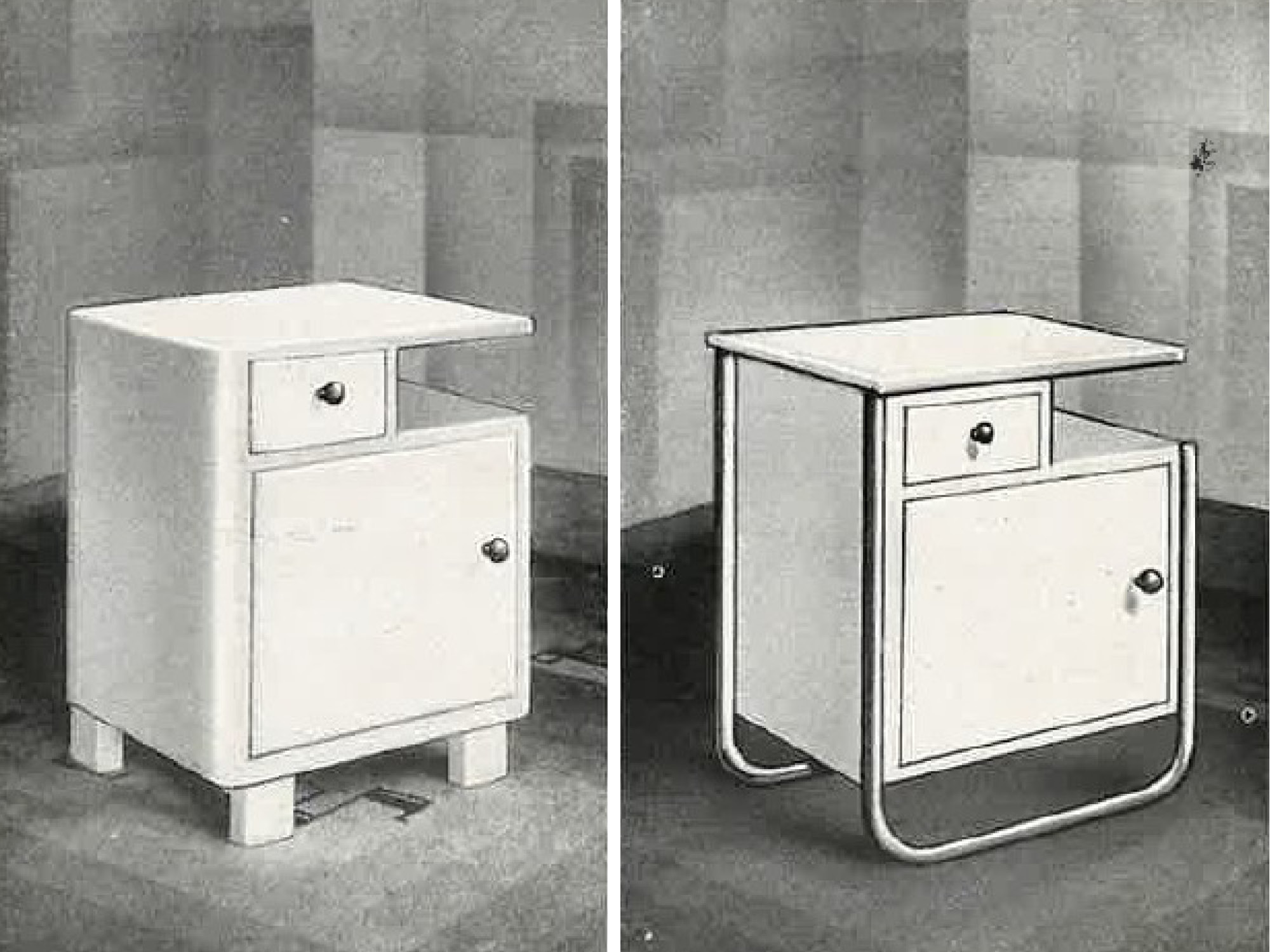
In one respect, however, the bedside cabinets lagged behind the development of beds for decades: they were not manoeuvrable. While many Stiegelmeyer beds could already be moved on small wheels between 1900 and 1910, the bedside cabinets stood firmly on their metal legs. This remained unchanged for a long time. Stiegelmeyer's range of bedside cabinets around order number 289 remained unchanged during the 1910s and 1920s. The 1931 catalogue features an additional innovation that points to the future: for the first time, homelike wooden bedside cabinets are also offered to private customers. For example, number 332: ‘Wooden bedside cabinet with glass top, two drawers with a small open compartment at the same height and a closed compartment’.
The end of non-rolling bedside cabinets first dawned in our printed catalogue of 1937. Following the great success of a new Stiegelmeyer bed for Berlin's Charité hospital in 1935, a full-time ‘hospital furniture department’ was finally established in Herford, and the portfolio exploded with modernity. Although the bedside cabinets still stand firmly on their legs, something similar is rolling around: servers, referred to in our catalogues as ‘bed tables’ or ‘overbed tables’.
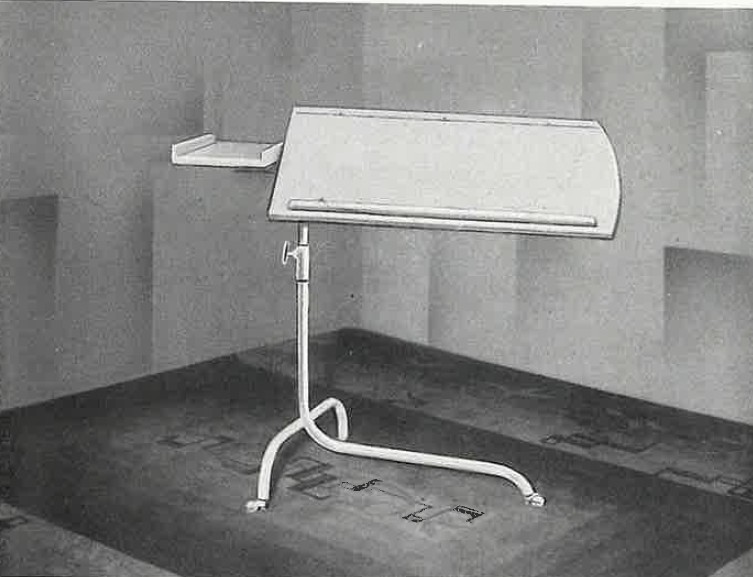
Their purpose is to administer food and medication to patients in bed or to provide a reading surface. The ‘standard bed table’ No. 6490 could already do everything in 1937: it was manoeuvrable, height-adjustable, swivelling and even had a two-part table top, one part of which could be tilted for reading and the other kept horizontal as a drinks tray. The discrepancy between the advanced servers and the old-fashioned bedside cabinets can perhaps be explained by the fact that patients at that time did not bring so many things with them that they needed a complex storage space.
In the 1950s, Stiegelmeyer bedside cabinets finally began to have castors, and that's not all. In the 1955 catalogue, a revolution suddenly took place: ‘No. 6181 – Bedside cabinet, combined with adjustable bed table, sheet steel box, tubular steel legs shaped into outriggers at the rear, four castors, closed sides and rear, can be used on both sides.’ In the 6181A variant, there were even pull-out drawers on both sides instead of a closed rear.

Seventy years ago, the standard functionality of today's bedside cabinets was already widely available. The manoeuvrability offered many advantages: greater flexibility in room layout, transport during patient transfers, easier floor cleaning. However, the many variants in the catalogue suggest that hospitals also used less expensive solutions. For example, it was possible to order slimmed-down versions with two castors and two legs. Such a bedside cabinet can also be seen in our showroom: to move it, you have to lift it up by the legs on one side, like a wheelbarrow.
The next surviving catalogue dates from 1968 and marks an important turning point for Stiegelmeyer. In the early 1960s, it looked as though the company might shift its focus towards private customers. Mass-market space-saving and garden furniture, sold in department stores, brought the company high sales. Ultimately, however, this success proved to be a short-lived trend during the economic miracle. Towards the end of the decade, the management board made the wise decision to discontinue space-saving furniture and invest its expertise in wood and homelike comfort in the new nursing home division.

The 1968 catalogue shows this new beginning in all its modesty. Only one bedside table model is listed: ‘No. 5021 – Bedside cabinet, closed wooden box with drawer and door’. Fifteen years later, at the beginning of the 1980s, there were already 13 bedside cabinets in nursing homes. They still bear numbers instead of names, but they can already be recognised as the direct precursors of our bedside cabinets named after the turn of the millennium. The 1980s bedside cabinets are divided into two groups: they either have height-adjustable overbed tables or overbed tables that can only be folded up and down. In the nursing care sector, the folding family is still present today with the Cosano model, while Burmeier offers the classic folding Hermann model for homecare.
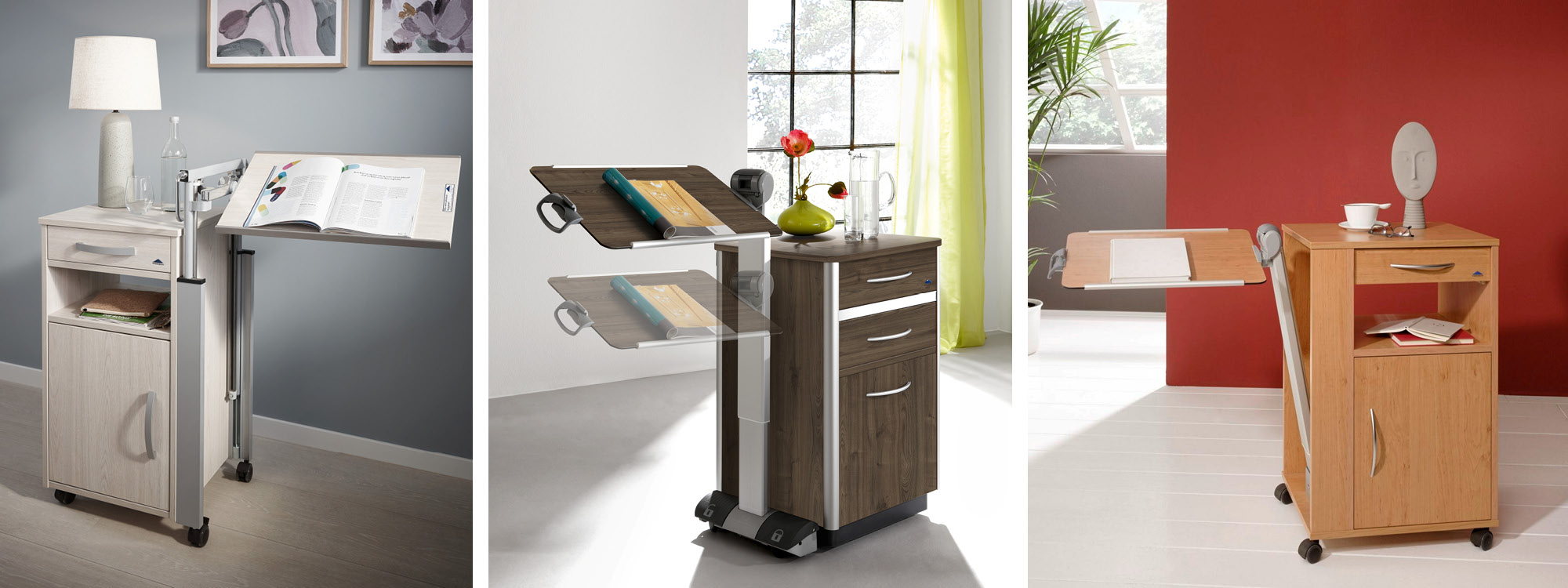
The mechanics of bedside cabinets bring us back to the original question posed at the beginning of this story: what defines a good bedside cabinet and what does a contemporary solution look like? In principle, height-adjustable overbed tables have been functioning as follows for many decades: they are attached to the side of the corpus, either in metal rails (as in the 1955 model), on an extendable column or on an extendable swivel arm. The tabletop is folded down when not in use. To use it, you have to set the desired height and fold up the tabletop. Some models can also be tilted to form a reading desk or moved to the other side of the corpus if the bedside cabinet is to be placed on the other side of the bed.
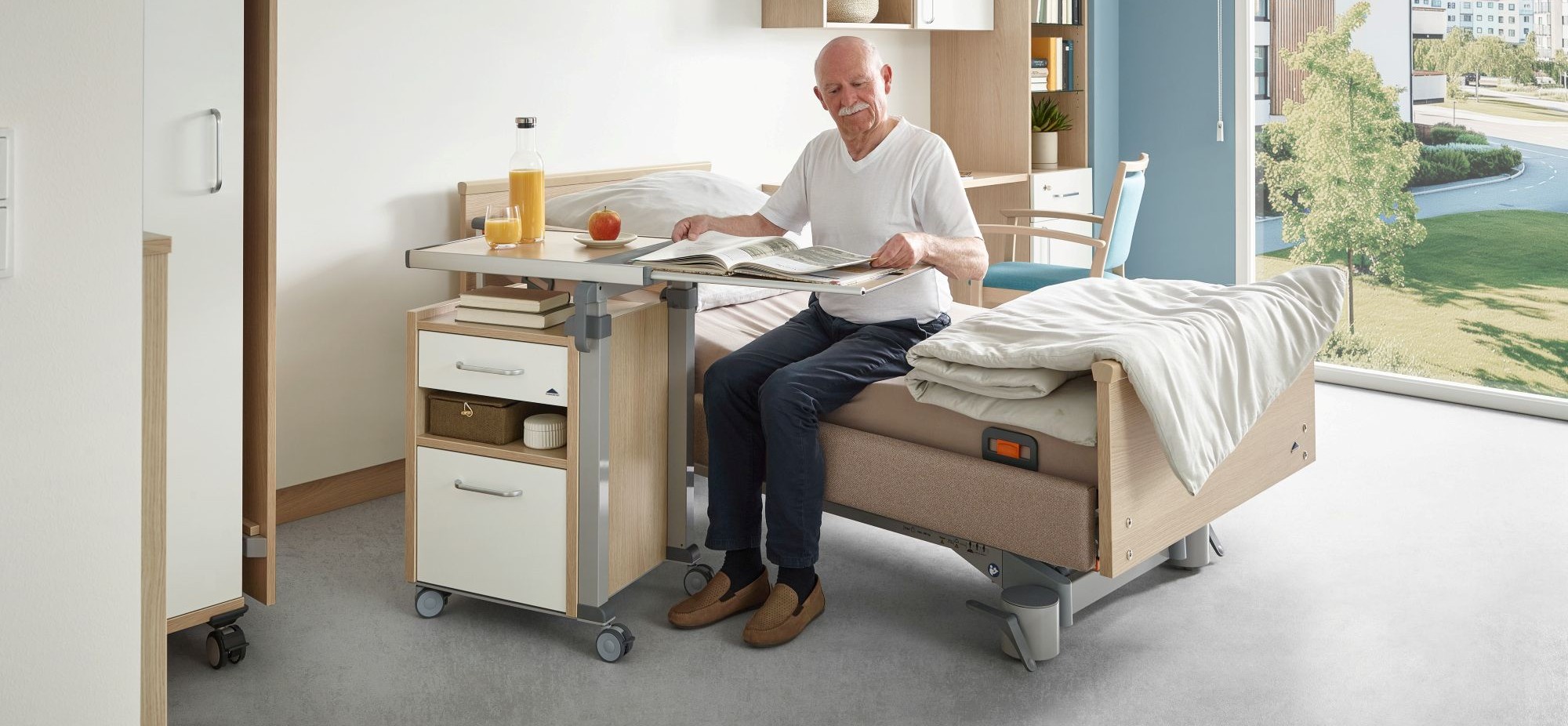
With the Aparto bedside cabinet, we have been breaking new ground. Its particular strength lies in its close connection to the people who actually work with it. The experiences and wishes of nursing staff have been incorporated into its development and have shaped many of its details. The Aparto revolutionises the technology of adjustable overbed tables. Now easier than ever before, residents can operate the horizontally extendable table top from their beds, which no longer needs to be folded up and down. Height adjustment requires almost no effort. This means more relief for nursing staff and more independence for people in need of care. In addition, the rotating corpus solves the problem of positioning on both sides of the bed more elegantly than ever before. It ensures that the Aparto can be used anywhere in seconds without the overbed table having to be repositioned by the building services department.
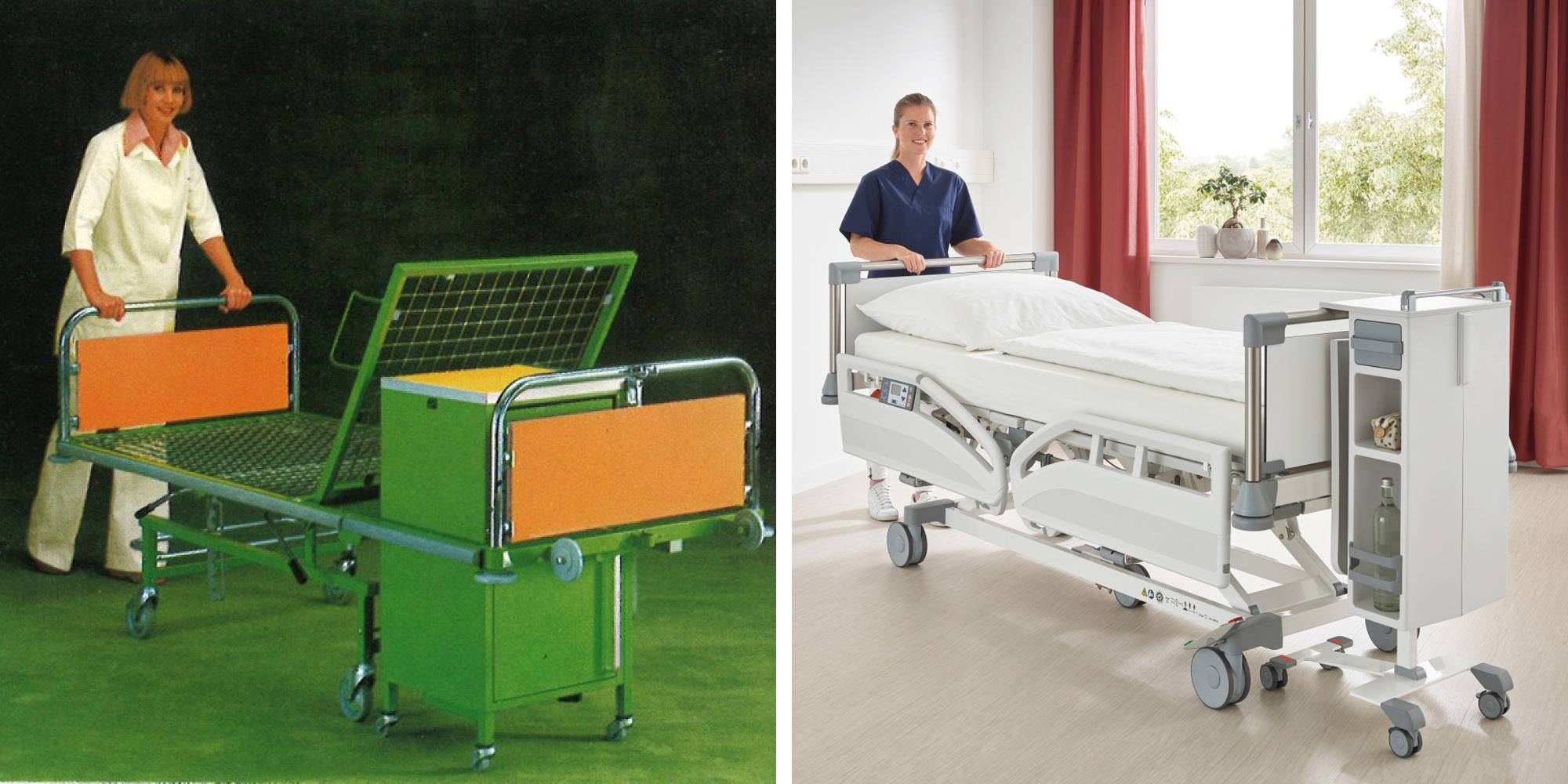
Bedside cabinets have also become a driving force for innovation in the hospital sector. The slim Quado continues the great tradition of our modern servers. It is a bedside cabinet, server and, if desired, a ward trolley all in one. And it convincingly solves a challenge that our developers had been working on since the 1970s: it can be attached to the head and footboards of the bed and simply be pushed along with it. Fifty years ago, this joint transport required opening the frame of the hospital bed like a fence gate, folding up the footboard and sliding the bedside cabinet into the bed frame. This procedure was just as unpopular as the grass-green colour of the bedside cabinets of the time.
In the era of smartphones, patients have new requirements, especially when it comes to optional services. Our Vitano electric bedside cabinet offers modern charging and connection options right at the hospital bed.
How will the more than 100-year history of bedside cabinets continue? The Stiegelmeyer Group positions itself as a solution provider for intersectoral care for people throughout their entire life cycle. Perhaps this will also blur the product boundaries between hospitals, nursing homes and homecare. Everyone should be able to benefit from as many advantages as possible. One thing is certain: whoever is looking for a safe place to put their book, glass, mobile phone or photo of their loved ones before going to sleep will find it with us.